By: Chris Butler and Marc Ruskey
Maybe you have had an experience like this. I (Chris) recall the day I desperately wanted an ice cream cone and, having discovered that a Baskin-Robbins, an ice cream vendor I had not previously tried, was a short distance away, I set out with eager anticipation. As I entered the store, I was confronted by an enormous sign that pictured all 31 Baskin-Robbins ice cream flavors. When my turn to order came, I remember rapidly scanning the images of ice cream options, analyzing the choices, and trying to decide which one of those delectable flavors would be mine. At least a minute passed, maybe two, although the growing impatience of the couple behind me made it feel like I was taking much longer.

Or perhaps you have had a similar experience in a restaurant, seemingly in mental paralysis, while trying to choose your food items off a menu with pages of choices, only to suddenly find yourself intrigued by a delicious looking plate being carried to a nearby table and saying to yourself ‘whatever that is, that’s what I’m having!’ Every day we are faced with decision making situations in which there are a multitude of possible acceptable options to select from.
The fascinating complexity of choice and its impact on human decision making is what drove researchers William Hick and Ray Hyman to seek to understand certain aspects of this relationship. In the early 1950’s Hick and Hyman conducted a series of three experiments specific to the interaction between people and their use of computers, an emerging technology at that time.
Hicks’ 1952 study was certainly an influential landmark in psychology and played a seminal role in the study of cognitive psychology, so much so, that Hick’s subsequent publication “On the rate of gain of information” established one of the few widely acknowledged laws in psychology called ‘Hick’s Law,’ which stands as one of the most researched and widely accepted principles of human behavior. In fact, Hick’s Law is foundational science for applied design disciplines and is cited in several textbooks on human factors and ergonomics (Proctor & Van Zandt, 2008: Wickens, Hollands, Parasurman, & Banbury, 2013; Salas & Maurino, 2010; Salvendy, 2012).
Hick’s experiments were conducted under conditions in which the study participants had to select a choice from an increasing number of stimulus-response alternatives. They were directed to make the correct choice as quickly as possible, without making errors, from the list of items that presented themselves. Through these series of experiments, Hick discovered that as the number of stimulus-response alternatives (choice options) increased, reaction time to choose the correct stimulus also increased. In fact, this effect was so stable and predictable that Hick developed a complex logarithmic formula which can be used to calculate the relationship between choice options and reaction time, as well as frequency of error (which Hick termed ‘residual entropy’) with increasing choice options.
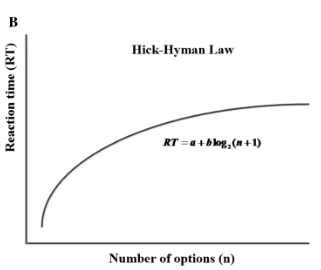
Even today, we see the impact of Hick’s law all around us. Professionals who study ergonomics and design complex systems (aviation, nuclear power, offshore drilling, medicine, and website and smartphone design, among many others) rely upon the principles of Hick’s Law. For example, the computer design textbook ‘Universal Principles of Design (Lidwell, Holden & Butler, 2010) states that “Designers will improve the efficiency of design by understanding the implications of Hick’s Law.” Indeed, although Hick’s Law was established in 1952, the multiple studies that have been conducted since that time have found consistent reliability in Hick’s original research.
Hick’s Law in Law Enforcement
Attend a law enforcement tactical training event and you’d be hard pressed not to hear Hick’s Law lectured or referenced. Many trainers have (incorrectly) applied Hick’s Law to human performance in the realm of decision making in rapidly unfolding, high-stress encounters, such as officer-involved shootings and other use of force incidents involving physical control techniques. It is frequently said that if we give officers too many techniques or too many tools on their belts, their performance will become impaired operationally because of Hick’s Law. Some of these trainers merely parrot what they have learned from previous trainers in a kind of pernicious ‘inbreeding,’ which causes the error to continue to be perpetuated. However, we must stop and ask the question, what exactly is Hick’s Law? Does it relate in any way to decision-making during a crisis event? And if not, what type of decision-making is present in these encounters and how do we properly apply that understanding to the law enforcement training realm?
First, Hick never studied the impact of choice options and decision-making on reaction time in these types of encounters. With all due respect to W.E. Hick, it is unlikely that he would approve of the misapplication of his research into law enforcement training. Recently however, some trainers have recognized the fallacy of applying Hick’s Law to rapid stimulus-response types of decisions, leading some, regrettably, to arrive at the opposite and equally erroneous conclusion that Hick’s Law is ‘junk science.’ To be very clear about this, Hick’s Law is called a ‘Law’ in psychology for a reason – over 70 years of research supports it. No, the problem is not that Hick’s Law is ‘junk science,’ rather, perhaps we as trainers have failed to correctly understand Hick’s Law from the beginning and have therefore misapplied the Law to a sphere of human performance that it does not belong. So, as professional trainers, let us avoid both ‘ditches’ of incorrect thinking and look to ensure our training is based upon a proper examination and application of the existing body of research and current theory of decision-making in the spontaneous, life-threatening events officers often find themselves. To better understand the processes by which we make decisions, whether they be rapid or slow, we need to examine some of the factors that impact decision-making.
Models of Decision Making
So, how do we make decisions? We just decide, right? Whether we know it or not (usually, we are not consciously aware of how we make decisions, as you will see), we use decision-making models all day long, from rational (explicit) to intuitive (implicit) models. One well known decision-making framework frequently applied to the law enforcement and military world is the famous ‘OODA Loop,’ developed by Colonel John Boyd of the U.S. Air Force during the Korean War. Wait, wait, wait, what’s an OODA Loop? No problem, here is a short, and if you’ll forgive us, overly simplified, explanation and example. OODA – Observe. Orient. Decide. Act. You Observe (gather information) with one or more of your senses (you smell fresh baked cookies). You Orient (you realize your wife has been baking). Once oriented, you Decide if/what action to take and possible outcomes (maybe just eat one and pretend they’re delicious, or man up and just tell her she’s no Betty Crocker). Then you Act, or don’t act, depending on what you decided! Pun intended.

To further help explain this, let’s use something familiar to most of us. Think of an OODA Loop like your phone’s GPS. You provide your phone with the initial observation (inputting your destination). Your phone orients by determining your current location, then calculating available routes to your destination, often providing options based on shortest travel time or shortest travel distance. You select the route (decide) and begin driving (act). During your travel, this loop will continually cycle, as perhaps you stop for gas, or miss a turn, and your GPS will go back to observing your new location and re-orienting to update the route, etc.
The OODA Loop process is far more complex than this, but for the sake of simplicity for this article, we will stop there. The common theme here is time. There is time to consciously observe, orient, decide and act. However, ‘time’ is not a luxury that is often afforded to officers in, for example, a close quarter assault, or gunfight.
To help us understand how we ‘decide’ an action, either when we have an abundance of time (discretionary time), or an extreme lack of it (non-discretionary time), we should look to the theory of thinking systems postulated by Dr. Daniel Kahneman. In his monumental work “Thinking Fast and Slow”, Dr. Kahneman describes thinking within a framework of two ‘systems’: System 1, and System 2.
System 2 thinking is primarily engaged when we have more discretionary time, and it is typified by logical, rational, analytical, and constructive thinking. System 2 thinking is conscious and intentional and requires more effort.
System 1 thinking is the near-instantaneous, stimulus/response, process that allows us to quickly respond to circumstances. This type of thinking requires little, or even sometimes no, conscious effort. It is driven by intuition and experiences.
Let’s explore a couple of examples to help understand System 1 and System 2 processes.
When you are at home in the morning preparing to drive to work, perhaps you give thought to the route you are going to take, you likely open the traffic app on your phone or listen to the traffic report on the radio. You make decisions about the route you are going to take based upon this careful analysis. As you begin driving, you scan the roadway ahead, constantly assessing the traffic and pedestrian patterns, making numerous decisions to avoid problems, all to make your drive as efficient as possible to arrive at your destination. This is all what Kahneman would refer to primarily as System 2 thinking. You have thought analytically, and constructively and you have engaged in consequential thought processes.

Now imagine a pedestrian suddenly decided to jaywalk directly in front of your oncoming vehicle. If you attempted to engage in a logical analysis of your options – ‘I could steer left to avoid, but what happens if I do that? Can I steer to the right? How much brake should be applied in conjunction with my steering? Etc.’ – even for the briefest period to attempt to weigh your options, before realizing what has happened, you would have run over the pedestrian. Instead, as the driver, you find yourself rapidly and automatically slamming on the brake and grasping the steering wheel with a firm two-handed grip, you experience ‘lid lift’ as your eyeballs snap open like dinner plates and all of this is immediately accompanied by an incredible cascade of physiological responses designed to help you survive the encounter. In this circumstance, you do not, indeed cannot, engage in a thoughtful decision-making process. Instead, you experience what Kahneman describes as System 1 thinking: that near instantaneous, reflexive, unconscious, stimulus/response process.
Or let’s take an example directly from the law enforcement realm. You are an officer following a vehicle that you observed committing a moving violation. You decide to pull the vehicle over and issue a violation to the driver. While following the vehicle, if you’re a switched-on copper, you are engaged in an extensive perception and risk assessment process before you ever put your lights on, making observations of the driver, the occupants, and the environment. What are they doing? Are there suspicious furtive movements that may be indicators of contraband or weapons in the vehicle? You run the license plate to see if the vehicle is properly registered and if there are any ‘hits’ on the vehicle or the registered owner. Is there a caution for violence, weapons, drugs, etc.? You are making observations of the traffic and roadway pattern up ahead and making decisions about the most appropriate and safest place to pull this vehicle over. You radio in your location or enter the traffic stop into your in-car computer. As you stop the car you are planning your approach. Will I make a driver’s side approach or a passenger side approach? You are considering your egress routes should you need to move quickly and where the best cover from fire is located. You get the idea. According to Kahneman, what system of thinking primarily is this process? If you said System 2, of course you’re bang on.

Now imagine however, as you are approaching the offending vehicle on foot to make contact with the driver, while nearing the B Pillar of the driver’s door, he suddenly produces a handgun, points it at you and begins firing. This is where System 1 thinking processes take over. You must not stop and reflect like Aristotle on your options. You must act instantly to win this encounter. In fact, you don’t even remember making the decision to draw your firearm but suddenly it is in your hand. You don’t remember making the decision to start running laterally, but there you are, running. And you certainly didn’t bring all the case law to mind that authorizes deadly force and whether criteria are met. Instead, you find yourself pointing your firearm at the threat and pulling the trigger as quickly as possible. If you have trained and prepared yourself well, your System 1 will keep you alive.

Under these types of rapidly unfolding circumstances, when time is compressed and urgency of response is demanded, our unconscious mind steps in and expedites our decision-making process; a model known as Recognition Primed Decision-Making (RPD), discovered by Dr. Gary Klein.
Shortcuts to Effective, Rapid Decisions
In the RPD model, under rapidly unfolding, unpredictable, high stakes events, when there is no time to think of and weigh all available options, our minds operate off of heuristics – mental shortcuts. The reality is everyone uses heuristics (also called ‘schemata’ or ‘rules of thumb’) and we do so all the time. For example, when you go to the doctor for a check-up, as soon as your doctor enters the room and sees you, he or she is automatically making assessments of your condition just from your visible appearance before a single objective test is performed. How can they do this? By using heuristics – a brain chocked full of years of experience in assessing and diagnosing patients. I (Chris) recall going whitewater rafting on one of North America’s most wild rivers. My guide was scanning the river ahead and perceiving hundreds of subtle cues – The water flow patterns, eddies, currents, as well as dangers in the river such as downed trees called ‘strainers’ that can rip people off the raft, or logs under the surface of the water called ‘dead heads’. As a result of his perception of the environment (Observe), he was able to understand the critical cues (Orient), make the correct decisions well in advance (Decide), and deftly maneuver the raft to the optimal position (Act). I didn’t have a clue what all these subtle cues meant or even what they would look like if I was staring at the same thing as my guide. He could do it, rapidly and mostly unconsciously, because of a well-formed heuristic model developed by years of experience. Police officers use heuristics all the time in order to determine what is likely to happen, anticipate those actions, and to prime ourselves for effective responses in crisis situations.

The urgency of these encounters doesn’t grant the necessary time to await a full picture of what is occurring or is likely about to occur. Instead, we use what some psychologists call ‘thin slicing’. This refers to the fact that as we are perceiving a situation, we only utilize a ‘thin slice’ of the totality of the available information in order to come to a conclusion about what we believe to be happening and to judge potential future outcomes. For example, when you looked at the image to the right, your brain very quickly informed you of what was occurring. You either saw a man running into the forest or a dog running towards you. Analyze it carefully, now you can see both although one will still be the dominant perception. What you have just experienced in the brain’s heuristic using the thin-slicing process to determine what was happening. By the way, this is an example also of how System 1 and System 2 are working together to help you make sense of your world.

Engaging in this process forces us to pull from past experiences, training and/or mental simulations and rehearsals, to expedite decisions. If you’ve been a cop for a minute, it’s likely you can recall an event where you’ve utilized the RPD model. One example most of us can relate to is going to place handcuffs on a suspect. You’ve ordered them to turn around and place their hands behind their back. While it seems you have compliance, you suddenly get ‘that feeling’ they’re going to run, and you quickly close the gap and make contact. While you may not have consciously analyzed what was taking place, your unconscious mind was certainly at work. The suspect gave you the subtle look over their shoulder, assessing your distance, size, appearance, etc. He/she then scanned for the best escape route while simultaneously turning a foot toward that direction, adjusting their pants and shifting their posture. Yes, your unconscious mind processed all those little cues to provide you with that gut feeling, causing you to act quickly. You have no remembrance of your mind ‘running’ an OODA Loop, rather, it quickly and efficiently identified cues from passed experiences that it had stored for an occasion similar to this.
By the way, this example reminds us, that according to Kahneman, the System 1 and System 2 processes are not an ‘either/or’ but a ‘both/and’ process under most circumstances. We are capable of using both deliberate, logical decision making and heuristic-based intuitive processes together. However, in times of very high stress-arousal, the automatic System 1 may override the critical thinking processes due to the demand to respond with urgency to solve life-threatening problems.
Another example of Recognition Primed Decision-Making is seen in talented EMS professionals. In CPR training you are taught a number of signs to look for in someone in cardiac arrest: unconscious, no chest rise and fall, skin discoloration, no movement, absent pulses, etc. For the novice facing this type of emergency, this assessment will be a step-by-step process, looking for these signs to decide if they should begin CPR or not. However, the skilled, experienced providers have repeatedly observed all the cues (signs) of patients in cardiac arrest, building up their mental rolodex (heuristic). The expert can view a patient in cardiac arrest and rapidly, likely without even checking a pulse, determine that CPR is needed and initiate care (no step-by-step checklist, it’s Recognition Primed – deeply engrained in their unconscious mind). Interestingly, Dr. Klein has found that not only do experts engage in this recognition-primed decision process, but they are often not even able to explain their decision process to others because it is so implicit. “Often experts do not realize that the rest of us are unable to detect what seems obvious to them.” (Sources of Power, p 151).
Decision Time, Response Time and the Effect of Training
Considering what you’ve read so far, let’s look at a highly time compressed scenario. As you are speaking with a subject within arm’s reach (inside the reactionary gap), they thrust a knife at your abdomen. What type of decision-making model will you utilize? Are you making an analytical decision (System 2), or is this a recognition-primed stimulus response (System 1)?
Let’s use some science to help assess this. We know through research that has been conducted (Bleetman, et al; 2003) that a knife thrust can be conducted in as fast as 0.14 seconds. To help put that time in perspective, a blink of an eye is between 0.10 and 0.40 seconds.
Other research (Lewinski, et al; 2013) has shown that it takes approximately 0.46 to 0.70 seconds to make an observation of a threat and start (not finish) a response. Using this data and basic math, we can see we are in trouble. That’s right, under typical encounters of spontaneous attacks at contact or near-contact range, we fall short of the time it takes to make an observation and begin a reaction, absent the pre-attack cues, at arm’s length. That’s not to infer an officer cannot defend against a knife-thrust in proximity, it just reveals that if you failed to pick up on the critical biomechanical cues and ‘tells’ (the indicators you recognize to prime your decision), you would be far behind the action/reaction curve and scrambling to catch up.
With that in mind, we have hopefully helped you reach a conclusion on what type of decision-making would be utilized in this time compressed example. If you were successful in seeing the ‘blur’ of the rapid attack coming towards you and instantly engaged in defensive action, you used System 1 Thinking, driven by the Recognition Primed Decision-Making process.
How does RPD work, and can we enhance our abilities to utilize it? We often attribute these gifts to being ‘gut feelings’ during the moments we experience them, but they are much more than that. The good news is that our minds are constantly developing this ability by storing and cataloging endless cues from past experiences. Even better news, we can improve this process through rich training, mental simulations, and rehearsals.
One area of police training that remains largely ‘untapped’ is improving rapid and accurate decision-making by teaching officers what the pre-attack biomechanical cues look like. What does it look like, biomechanically, for a person to reach in his back waistband to draw a weapon, verses reach into his back pocket to pull out a wallet? What do the cues look like that predict a gun-grab or a tackle attempt? There is almost no end to the potential movement patterns and cues that could be conducted in a variety of realistic drills and/or captured in images and videos and shown to officers. Interestingly, in the world of high-level athletics, these types of performance cues are taught all the time using contextually rich drills, images and video occlusion techniques in order to leverage what is called ‘motor observational learning’. Some researchers (Helsen & Starkes; 1999) have begun to explore the effect on performance of police officers who have been trained to recognize the early cues of aggressive behavior. The positive results on anticipation, speed of reaction and accuracy of judgment are profound when compared to officers who have not received this training. In athletics, this is done to help a performer win a medal. Should we not be doing the same in law enforcement to help officers save their lives? Research (Suss, J. Ward, P.; 2013) on using occlusion decision-making techniques in law enforcement suggests this is an area of low-hanging fruit with which trainers can enhance officer performance.
Additionally, being aware and mindful, as well as taking time to analyze critical events you have experienced, or are likely to experience, will certainly improve how well we perceive cues in the future. Another great way to enhance decision-making is by watching and analyzing BWC footage and other video footage; in essence, building second-hand (vicarious) experience. But don’t simply watch the videos. Imagine and experience the event(s) mentally and rehearse how you would respond. Speaking of mental rehearsal, the performance enhancement effects of utilizing imagery are almost unbelievable.
Did you know that the motor cortex in the brain, which is responsible for organizing and initiating all intentional motor action, does not know the difference between an action that is physically performed and one that is powerfully imagined as being performed? This is because intending to perform an action, observing an action, executing an action and imagining an action all share the same functional networks in the brain. And if that wasn’t ‘mind-blowing’ enough, the act of imagining, when performed effectively, causes the motor cortex to already begin ‘wiring’ the identical motor programs needed to perform the imagined action. We’ve all heard the theories on how many repetitions or how many hours it takes to master a skill, but would you have ever guessed that mental imagery can both expedite this process as well as make the response actions more durable and reliable? We could spend a lot of ink talking about the critical importance of imagery, and we probably will in a future article.

To reiterate, in rapid, high-consequence events when the critical stimulus presents itself, your unconscious mind (System 1) will quickly identify and initiate a response. The decision phase (prior to the start of your reaction) will be completed almost immediately regardless of the number of potential options available. However, we all have time constraints in training. While our time to decide the response will almost be unaffected, our total response time (time to start to react AND complete the reaction) will certainly be impacted by the quality and quantity of training, irrespective of the number of potential options available.
For example, imagine training 20 hours a month on 20 different martial arts techniques (1 hour per 1 technique). Another martial artist, given an equal training time of 20 hours, uses just 4 techniques that defend against all the same attacks as your 20 techniques (5 hours per 1 technique). All other factors being equal, having 5 hours of training per technique, versus 1 hour each, will obviously result in more efficient and automatic responses available to choose from. If our minds push forward the first appropriate response to a rapid threat (RPD model), fewer techniques rehearsed may not mean a faster decision, but fewer choices likely mean a more proficient response from the trained response being selected.
Let’s go back to the scenario with the suspect preparing to run. Imagine carrying a taser, asp, OC spray, and bola wrap, and being a skilled martial artist. Even with all those options, we now understand in intense, rapid situations, our minds are picking the first workable option, without weighing all the options before deciding. So, when you chose to close the gap to gain physical control, your mind wasn’t saying – ‘wait, what about the taser, oh never mind, we have this new bola wrap, maybe I should try that’. Your mind gave you the first workable option and you acted. It takes the first option, even if it might not be, in hindsight, the ‘best’. Again, having all these choices will not significantly impact your decision time, but it may impair the overall efficiency and effectiveness of your response, as you have divided your training time amongst numerous options and have never trained to a high level of proficiency on any of them.

One of the current challenges in law enforcement training is a lack of research-based methodology in choosing, not only the type of techniques that should be trained, but the way in which those techniques will best be taught. Two things are known with almost certainty. First, the techniques presently taught to officers in the academy become virtually useless and non-operational within 6 weeks of graduating the academy. Secondly, the multitude of techniques that officers are taught are never taught to the level of performance needed for the retention and transfer to the novel conditions that officers face on the street. This is a call to action. Perhaps it is time to reimagine our training to ensure fewer techniques are taught to a greater level of proficiency using proper pedagogical motor-learning training methods. More proficiency in these fewer techniques will produce officers with greater confidence, speed, and judgment when confronted with violent attacks at close ranges.
So, what about Hick? Trainers, it is time to leave the Hick’s Law debate behind us. Hick never intended for us to abduct his law and bring it into an environment that is foreign to the one he was studying. Conceivably, the reason Hick’s Law is so often referenced in law enforcement is because many trainers realize the value of ‘less is more.’ Not for the reason of faster decision making, but because having fewer trained responses translates into more dedicated training time per response, in turn building more effective skills to a greater level of automaticity. Let’s move forward ensuring our training prepares officers to meet the critical demands on the street so when an officer is confronted with a life-threatening stimulus, recognition primed decision-making can empower System 1 to do what it needs to do – drive forward an immediate, effective, and confident motor response to defeat the threat.
About the Authors.
Marc Ruskey entered public safety in 2005 serving both in EMS and law enforcement, with roles as an FTO, patrol sergeant, and chief. As an instructor in various topics, Marc’s passion is defensive tactics, with over 20 years in martial arts, which has contributed to his development of edged weapon courses and defensive tactics specifically to the law enforcement profession. Marc can be reached at mruskey@nwosir.com
Chris Butler has spent over 25 years developing and instructing training in high-angle Search and Rescue and Law Enforcement Use of Force including firearms and combatives. Chris is a principle senior instructor for Raptor Public Safety in the US and Raptor Protection in Canada and an instructor for Force Science. The principles discussed in this article are thoroughly covered during the Methods of Instruction Course (outside the US at https://raptorprotection.com/methods-of-instruction/ and within the US at https://raptorpublicsafety.com Chris can be reached at chris@raptorpublicsafety.com
Sources
- Hick, W.E.; On the Rate of Gain of Information; Quarterly Journal of Experimental Psychology; Vol. (9), pp. 11-26; 1952.
- Hind, N; The Rate of Gain of Information – An Investigation; University of New Brunswick; Fredericton New Brunswick; Conference for Advanced Motor Control and Learning; January 2015.
- Proctor, R. & Schneider, D.; Hicks Law for Choice Reaction Time: A Review; Quarterly Journal of Experimental Psychology; Vol. 71(6), pp 1281-1299; 2018.
- Hughes, N.; Hick’s Law is Junk Science; How to Be Your Own Bodyguard; Retrieved October 19, 2022; https://h2bg.com/blog-posts/hicks-law-is-outdated/
- Kahneman, D.; Thinking Fast and Slow; Anchor Publishing Canada; 2013.
- Klein, G.; Streetlights and Shadows; MIT Press; 2009.
- Slepian, M. Bogart, K. Ambadi, N.; Thin Slice Judgments in the Clinical Context; Annual Review of Clinical Psychology; Vol. 10(1) pp 131-153; 2014.
- Klein, G; Sources of Power: How People Make Decisions; MIT press; 1999.
- Bleetman, A. Watson, C. Horsfall, I. Champion, S.; Wounding Patterns and Human Performance in Knife Attacks: Optimising the Protection provided by Knife-Resistant Armour; Jounral of Clinical Forensic Medicine; Vol. 10(4) pp 243-248; 2003.
- Schiffman, H.; Sensation and Perception: An Integrated Approach; New York; John Wiley and Sons, Inc.; 2001.
- Lewinski, WJ, Dysterheft JL, Seefeldt, D, Pettitt, R.; The Influence of Officer Position on Movement During a Threatening Traffic Stop Scenario; Law Enforcement Executive Forum; Vol 13 pp 98-109; 2013.
- Helsen, W. Starkes, J.; A New Training Approach to Complex Decision Making for Police Officers in Potentially Dangerous Interventions; Journal of Criminal Justice; Vol. 37 pp 395-410; 1999.
- Suss, J. Ward, P.; Investigating Perceptual Anticipation in a Naturalistic Task Using a temporal Occlusion Paradigm; Proceedings of the Human Factors and Ergonomics Society 57th Annual Meeting; 2013.
- Post, P. Williams, C. et al.; The Effects of PETTLEP Imagery Intervention on the Learning of a Complex Motor Skill; Journal of Imagery Research in Sport and Physical Activity; January 2015.
- Norouzi, E. Norouzi, R.; Examining the Effectiveness of PETTLEP Imagery Intervention on the Football Skill Performance of Novice Athletes; Journal of Imagery Research in Sport and Physical Activity; Vol. 14(1); October 2019.
- Mulder, Th.; Motor Imagery and Action Observation: Cognitive Tools for Rehabilitation; Journal of Neural Transmission; Vol. 144(10) pp 1265-1278; October 2007.
- O’Neill, J. O’Neill, D. Police Academy Training, Performance and Learning’; Behavior Analysis in Practice; Vol. 12, pp 353-373; 2019.